The Spring and Autumn and Warring States periods marked a crucial turning point in the development of ancient Chinese monetary systems. During this era, the declining authority of the Zhou royal court allowed regional vassal states to independently mint their own metal currencies. This historical shift created a unique multi-currency system across the nation. Boosted by rapid commercial growth and advanced metal casting techniques, regional economies flourished, resulting in diverse coin shapes and overlapping circulation territories throughout ancient China.
Four representative coin types dominated this historical stage: spade coins, knife coins, round ring coins, and Chu ant-nose coins. Each category featured exclusive shapes, regional usage ranges, and cultural origins, fully reflecting the regional characteristics and technological levels of early Chinese civilization.
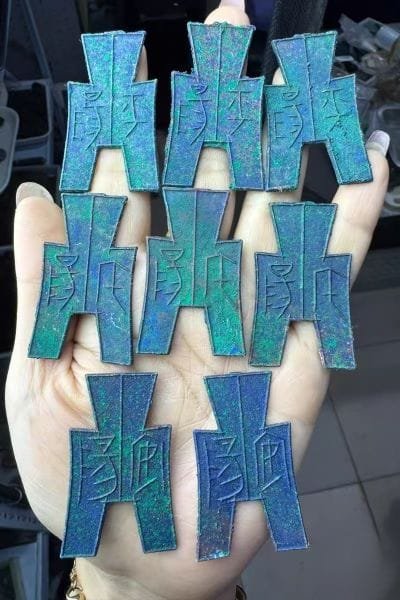
Spade Coins — The Earliest Farming-Style Ancient Currency
Among all Warring States currencies, Square Foot Spade Coin stands as one of the earliest standardized metal coins in Chinese history. Evolving directly from the ancient farming tool known as “bo”, or bronze shovel, spade coins first appeared in the early Spring and Autumn period and remained in circulation until the late Warring States era. These coins were primarily used in the Sanjin regions and territories governed by the Zhou royal family.
Spade coins are divided into two main categories: hollow-head spade coins and flat-head spade coins. Early hollow-head versions retained the complete structural features of farming tools, with hollow sockets for wooden handles, making them thick, heavy, and primitive in appearance. As casting technology improved, coins gradually became thinner, flatter, and smaller, evolving into flat-head spade coins that were easier to produce, carry, and trade.
Most flat-head spade coins were inscribed with place names such as Anyi and Jinyang, or weight units including Jin and Zhu. These inscriptions provide valuable historical evidence for studying ancient regional economies and measurement systems. Even during the Wang Mang reign of the Xin Dynasty, ancient-style spade coins were recast in tribute to traditional monetary culture. As typical shovel-shaped bronze currency of the Eastern Zhou Dynasty, spade coins represent the transformation from primitive barter tools to standardized commercial money.
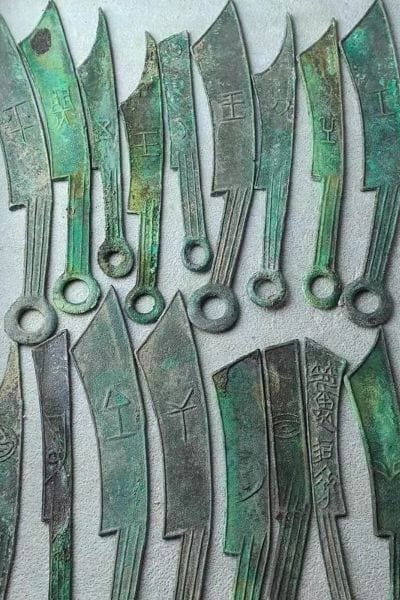
Knife Coins — Military and Hunting Tool-Style Currency
Popular in northeastern ancient China, Yan Ming Knife Coin developed from bronze cutting tools commonly used for hunting and daily labor during the Shang and Zhou dynasties. Characterized by a circular hole at the handle end and carved grooves on the handle body, knife coins were convenient for stringing, carrying, and large-volume commercial transactions.
This currency system flourished mainly in the State of Qi and the State of Yan, later spreading to Zhao and Zhongshan. Common types include pointed-head knives, round-head knives, arc-backed knives, Qi official knives, and Yan Ming knives. Different structural designs such as straight backs, curved backs, and folded backs distinguish regional versions, clearly showing localized minting characteristics.
Qi knife coins typically carry the character “Hua”, representing standardized monetary units of the Qi region. After Qin unified China, knife coins, shell coins, and spade coins were officially abolished and replaced by a unified national currency. Knife coins reflect the northern nomadic and hunting cultural background of ancient northeastern states and serve as important relics for studying regional commercial exchanges before imperial unification.
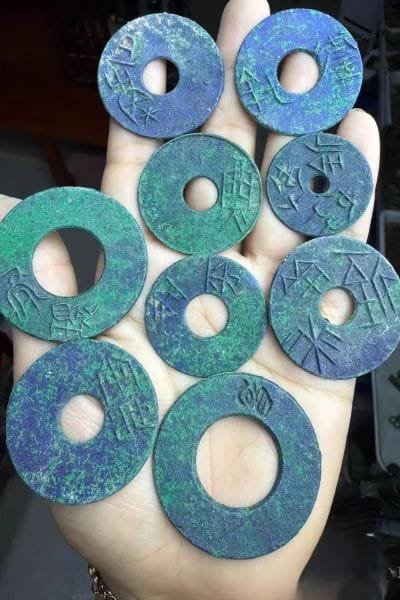
Round Ring Coins — The Origin of Traditional Square-Hole Coins
As the prototype of China’s later imperial square-hole coins, Round Ring Coin emerged as a simpler, more practical currency compared with bulky spade and knife styles. Mainly circulated in the State of Qin and the State of Wei during the mid-to-late Warring States period, ring coins were crafted in circular shapes with central holes, divided into two evolutionary stages: round coins with round holes and early round coins with square holes.
Early ring coins featured narrow central holes, while later versions expanded the hole size for easier stringing and storage. The obverse side was engraved with mint inscriptions and weight marks, while the reverse remained blank. Believed to evolve from ancient spinning wheels or jade ritual bi discs, ring coins symbolized ancient Chinese concepts of “round sky and square earth”.
Thanks to their portable size and unified round shape, ring coins gradually replaced irregular spade and knife currencies, laying the foundational design for the uniform copper coins used throughout China’s feudal dynasties. They represent the progress of ancient Chinese coin design toward standardization, simplicity, and mass circulation.
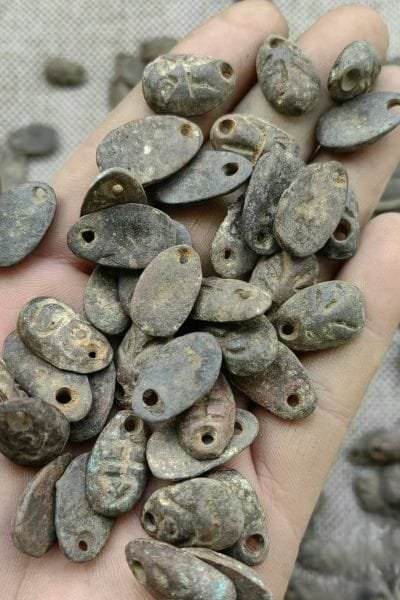
Chu Ant-Nose Coins — Unique Shell-Style Currency of Southern China
Exclusive to the ancient State of Chu in the Yangtze River basin, Chu Ant Nose Coin is a special bronze currency modeled after primitive shell money. Compared with the advanced tool-derived coins of the Central Plains, Chu’s monetary development was relatively late, retaining the ancient shell-imitating shape for a longer period.
Ant-nose coins feature an oval shell-like appearance with raised obverse surfaces and flat reverse sides, smaller and more delicate than natural shells. Large-scale archaeological discoveries confirm that these coins were widely circulated in Hubei, Hunan, Henan, Jiangsu, and Anhui provinces during the middle and late Warring States periods. A major excavation in Xiaozhuye Lake, Xiaogan, Hubei, unearthed over five thousand well-preserved ant-nose coins, averaging about 4.37 grams each.
Archaeological research shows that ant-nose coins began circulation in the early Warring States period, while the commonly known ghost-face coins became prevalent in the mid-to-late Warring States era. As Chu territory expanded southward and eastward, this unique currency system gradually matured, forming an independent and complete southern monetary culture distinct from the Central Plains coin systems.
Conclusion of Warring States Monetary Culture
The coexistence of spade coins, knife coins, ring coins, and ant-nose coins perfectly demonstrates the diverse regional economies, craftsmanship levels, and cultural customs of the Spring and Autumn and Warring States periods. The evolution from tool-shaped currency to standardized round currency records the entire development process of ancient Chinese monetary standardization.
Today, high-precision solid copper replicas of these four classic Warring States currencies allow cultural enthusiasts and antique collectors to appreciate the artistic details, casting techniques, and historical value of pre-Qin ancient coins, inheriting and displaying precious traditional Chinese metal craft culture.
If you need wholesale supply or custom craft solutions for ancient coin replicas, please contact us to get detailed product catalogs and exclusive bulk pricing